Lime Render for Older Solid Walls: Why Breathability Matters in Somerset Homes
Solid walls need breathable render to stay dry and healthy. We explain why lime render works for older homes across Somerset and Dorset, and how we can help.
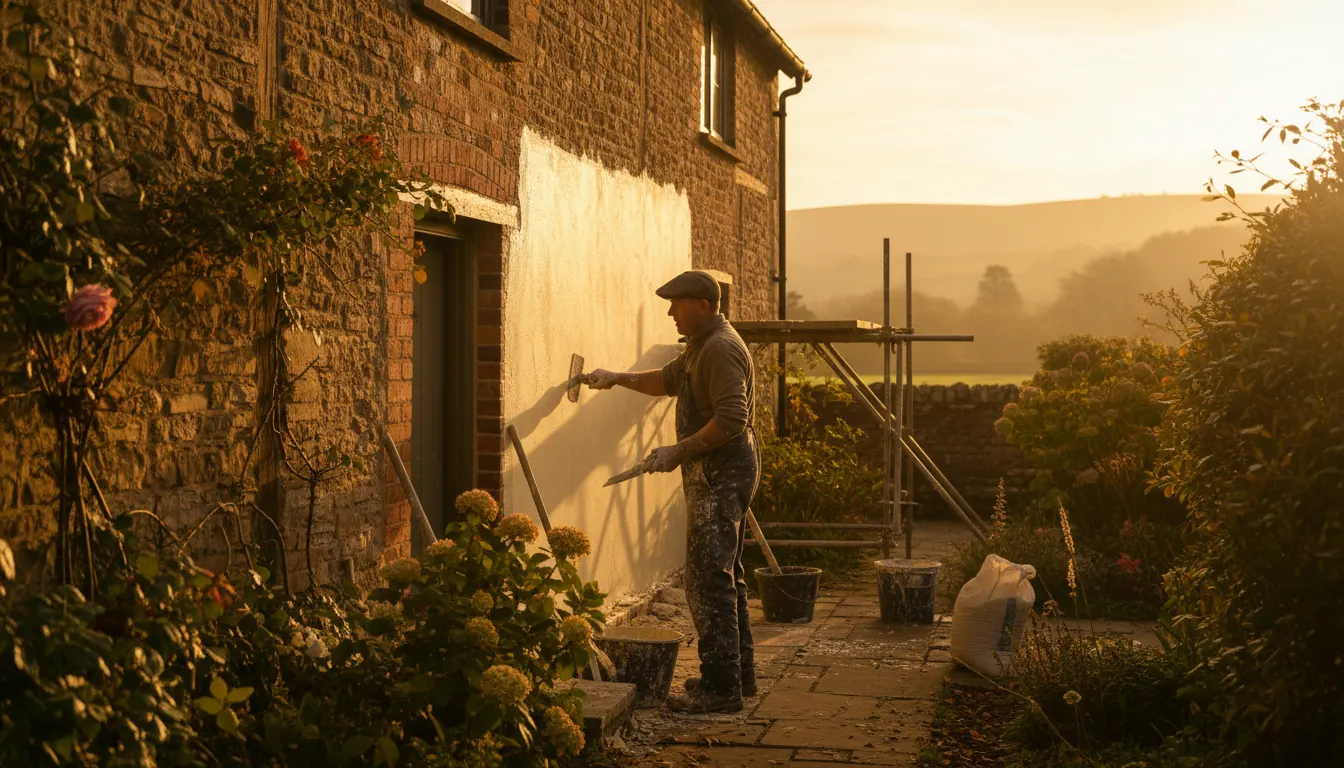
Why breathable render matters on older homes
Solid brick and stone walls do not work the way modern cavity walls do. They absorb moisture and then release it, cycling through wet and dry as the weather changes. That is completely normal and, if the right materials are used, completely fine.
The problem starts when a solid wall gets coated in something that traps that moisture inside. Hard cement render, applied to a Victorian terrace or an Edwardian semi, acts like a skin that will not breathe. Moisture that cannot escape pushes outwards against the render and eventually forces it off the wall in patches. Behind it you often find damp masonry, and inside the house you can end up with cold walls, condensation and blown plaster.
Breathable render for old houses solves this by letting the wall do what it was always designed to do: absorb a little, release a little, stay in balance.
What makes a render breathable?
A render is breathable when its structure allows water vapour to pass through it rather than blocking it entirely. Natural lime render has done this job on old buildings for centuries. Modern formulations of lime render do the same thing, often with improved workability and reliability on site.
The key difference from cement is the binder. Cement is dense and rigid. Lime is softer, more flexible and open in texture. That openness is exactly what allows vapour movement. It also means lime render can accommodate the very slight seasonal movement that old solid walls produce, which is why lime tends to stay bonded where cement eventually cracks and blows.
There are also modern through-coloured silicone renders that carry good breathability ratings, and we use those too on the right buildings. But for genuinely old solid-wall construction, a natural lime render or a modern lime-based product is usually the most appropriate starting point.
The problem with cement render on old houses
Across Somerset you will see it on older terraces in Bridgwater, on stone cottages near the Somerset Levels, and on period properties throughout the county: a coat of hard sand and cement render, applied at some point in the last fifty or sixty years, now cracking, blowing and letting water in behind it.
When cement render fails on a solid wall it tends to fail badly. The bond breaks away in large sections, and by the time it is visibly cracking on the outside, moisture has usually been sitting behind it for a while. Stripping it back and replacing it with a breathable alternative is the proper fix. Patching with more cement just repeats the same problem.
This is not a niche heritage concern. It applies to any pre-cavity-wall property: Victorian and Edwardian terraces, 1920s and 1930s semis, older stone farmhouses and cottages across Somerset and Dorset. If your house was built with solid walls and it has a cement render coat on it, it is worth understanding what that render is doing to the wall beneath.
Lime render: what it is and how it works
Lime render uses lime putty or hydraulic lime as its binder instead of cement. It is softer, more flexible and far more vapour-permeable than cement. Applied correctly, it bonds well to old masonry, copes with the slight movement in old walls, and allows the wall to breathe as it should.
We use lime render on:
- Older solid brick properties where breathability is the priority
- Stone walls where a hard render would crack with movement
- Properties where previous cement render has failed and needs replacing
- Internal solid walls that need a breathable plaster finish
Lime render is typically applied in coats, building up gradually. The scratch coat goes on first, providing a key for the subsequent layers. Each coat needs time to set before the next goes on. It is not a quick-fix product, but done properly it lasts extremely well and keeps the wall in good health.
For internal solid walls, a lime-based plaster performs the same function: it keeps the wall breathing and reduces the risk of condensation and damp patches forming at the surface.
Modern lime render versus traditional mixes
There is a version of this conversation that goes deep into traditional hot lime, natural hydraulic lime, different grades and regional variations. That is genuinely interesting if you are working on a listed building or a very old piece of masonry.
For most older houses in Somerset and Dorset, though, the practical question is simpler: does the render allow the wall to breathe, and is it compatible with the masonry it is going on?
Modern pre-mixed lime render products answer both questions reliably. They are formulated for consistent performance, they are easier to work with on site than traditional mixes, and they still provide the breathability that old solid walls need. We describe what we use as 'Modern Lime Rendering', and it covers the majority of older domestic properties we work on across Somerset.
If you have a genuinely historic building and need specialist conservation advice, that is a separate conversation. For the typical Victorian terrace in Bridgwater or the 1930s semi in Taunton with failed cement render, a modern lime-based product is the right answer.
What our customers say
Kim King left this review after we rendered the front of her property:
"Lewis has done an amazing job on rendering the front of our property. Very professional clean and tidy. Will have him back to do more work on our property"
- Kim King, via Google
That clean, tidy finish matters on a render job. Getting the surface preparation right, applying the material properly and leaving the site in good order are all part of the job for us.
Silicone render as an alternative on some older homes
Not every older house needs lime render. Some solid-wall properties have had their original render stripped back and the masonry repointed and stabilised to the point where a breathable silicone render is a perfectly suitable finish. Silicone render is flexible, highly water-resistant at the surface and available in a wide range of through-colours.
The decision between lime and silicone depends on the wall, its condition, and what the building needs. We look at each job individually. If you want to understand the differences in more detail, our article on Silicone Render vs Monocouche: Which Through-Coloured Finish Suits Your Bridgwater Home? covers the render finish options in depth.
Signs your old house needs breathable render
You do not always need to wait for render to fall off the wall. Some earlier warning signs are worth knowing:
- Render that sounds hollow when tapped (a sign it has lost its bond to the wall)
- Hairline cracks running across the surface, especially around windows and at corners
- Damp patches appearing on internal walls after wet weather
- Paint bubbling or peeling from the outside of the render
- Blown plaster on internal walls near external faces
Any of these on a solid-wall property suggest the render is no longer doing its job. Getting it assessed sooner rather than later usually means less remedial work overall.
Rendering and plastering: the two sides of the job
Breathable render is the external part. But if a solid wall has been trapping moisture for a while, the internal plaster often needs attention too. Damp that has been sitting behind failed cement render tends to work its way through, leaving blown, stained or crumbling plaster on the inside.
Once the external render has been replaced with a breathable alternative and the wall has had time to dry out, we can re-skim or replaster the internal face. Getting both sides right is what actually solves the problem rather than just treating the symptoms.
If you are dealing with a room that needs replastering after damp or after a repair, our article on Rendering vs Plastering: Which One Does Your Somerset Home Need? explains how the two trades connect and when you need one or both.
Frequently asked questions
How long does lime render last on an old house? Done properly on a well-prepared wall, lime render lasts a very long time. There is no single answer because it depends on the condition of the masonry, the exposure of the wall and how well the render was applied. What we can say is that lime render on a solid wall, applied in the right coats and given time to cure, outlasts cement render on the same wall. Cement fails by cracking and blowing; lime tends to weather more gracefully and can often be patched and maintained rather than stripped and replaced wholesale.
Can you render over old cement render on a solid wall? Generally, no. If the existing cement render is failing or has blown, applying new material over the top does not fix the underlying problem and the new coat will likely fail in the same way. The correct approach is to strip the failed render back to the masonry, assess the wall, prepare the surface properly and then apply a breathable render system from scratch.
Does lime render work on internal walls too? Yes. On internal solid walls, a lime-based plaster is the breathable equivalent of lime render externally. It allows the wall to manage moisture rather than trapping it at the surface. This is particularly useful on solid external walls where you want the inside face to breathe as well as the outside.
Do older houses in Somerset need breathable render specifically? Most pre-cavity-wall properties do, yes. The Somerset climate, with its wet winters and the additional coastal exposure around Burnham-on-Sea and the Bristol Channel coast, means solid walls see a lot of moisture. A breathable render system is not a luxury on these buildings; it is how you keep the wall healthy and the interior dry.
If your older property has failed render, damp walls or internal plaster that is showing signs of moisture damage, we are happy to come and take a look. We cover Somerset and Dorset and offer free quotes. Get in touch with us and we can talk through what your house needs.
“Would highly recommend Lewis. He done an amazing job at our home. Turning our house into a colourful pink. Very professional and friendly. Thank you so much.”