Plasterboarding and Dry Lining: Creating Smooth Interior Walls in Bridgwater Homes
Planning plasterboarding in Bridgwater or across Somerset? We explain dry lining, stud partitions and boarding ceilings before skimming, what to expect from start to finish.
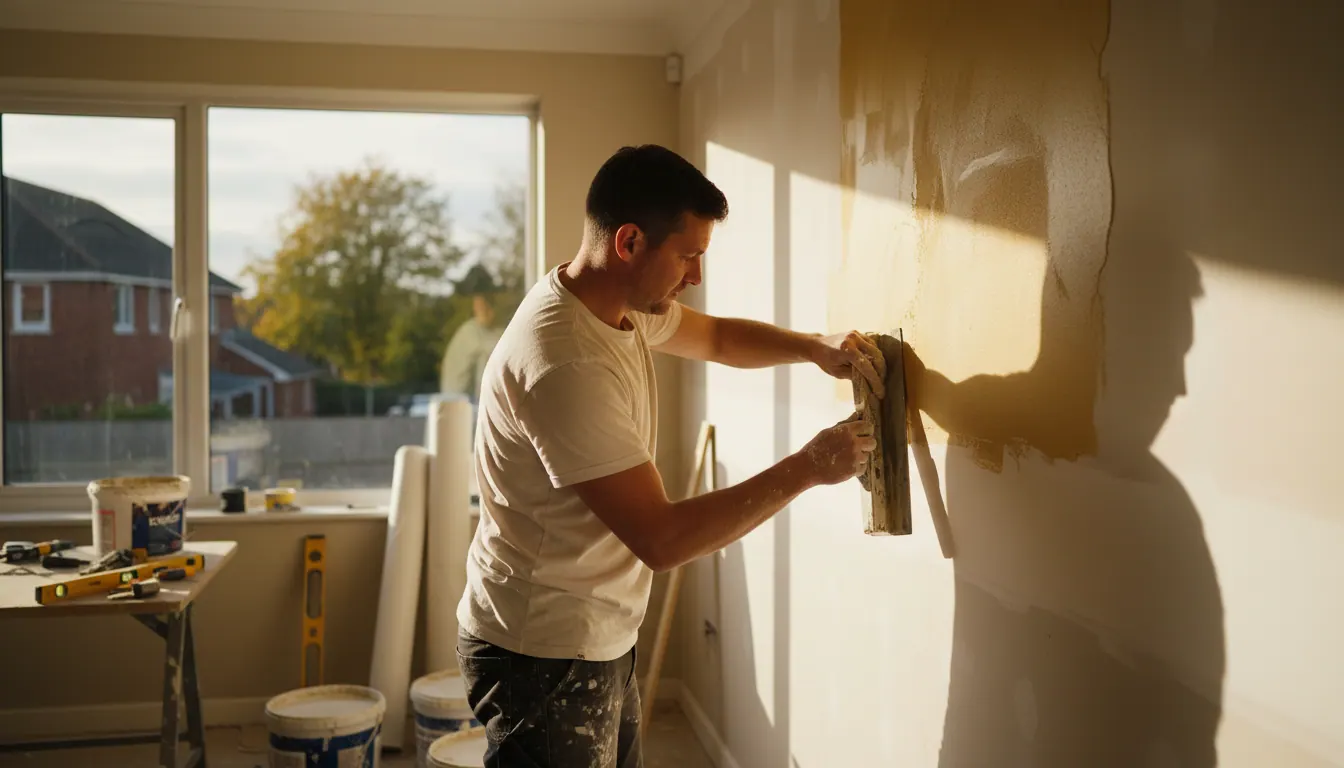
What Plasterboarding Actually Involves (and Why It Matters Before the Skim)
Plasterboarding is often the step that gets overlooked until the last minute. A builder frames up a stud wall, a contractor chases in the cables, and then someone needs to board and skim it before the room can be decorated. That someone is us.
Plasterboarding, or dry lining, is the process of fixing plasterboard sheets to a frame or directly to an existing wall or ceiling, then finishing the surface ready for paint. It is how most new walls, ceilings and partitions are created in modern construction, and it is also one of the most common jobs we carry out across Bridgwater and the wider Somerset area.
Getting the boarding right is the foundation of a smooth finish. Rush it, and no amount of skimming will save you.
When Do You Need Plasterboarding?
There are several situations where boarding is the right approach rather than plastering directly onto an existing surface.
New stud partitions. If you are dividing a room, adding a home office, or creating an en-suite, a timber or metal stud frame needs to be boarded on both sides before skimming. We work with the boards and skim coat once the frame is up.
Dry lining solid walls. Older solid-wall properties in Bridgwater and across Somerset sometimes benefit from dry lining on the inside face of an external wall. Rather than applying plaster directly to brick or block, boards are fixed to a timber batten or metal frame, then skimmed. This gives a flat, even surface.
Ceiling boarding. Whether it is a new extension, a room that has had water damage, or a ceiling that has simply had its day, boarding over or replacing the ceiling with plasterboard and then skimming is a clean, reliable solution.
New builds and extensions. On new builds and extensions throughout Somerset, plasterboarding is standard practice. Boards go onto the frame, joints and angles are taped, and then the whole surface is skimmed to a smooth finish ready for decoration.
If you are at the extension stage and wondering what comes next after the builder hands over, our article on Plastering a New Extension in Somerset: What to Expect Before You Fit Out walks through the process in detail.
Stud Partitions: Boarding Both Sides Properly
A stud partition wall is only as good as its boarding. The boards need to be fixed securely, cut cleanly around any openings, and jointed correctly so that the skim coat sits flat and does not crack along the joints later.
Key things we look for before we start boarding a stud partition:
- The frame is plumb and square (if it is not, we will flag it before we board, not after)
- Services such as cables and pipes are in position and signed off
- The correct board type is used for the location (standard board for most rooms, moisture-resistant board in bathrooms and kitchens, fire-rated board where required)
- Joints fall on studs wherever possible, so the boards are properly supported at their edges
Once the boards are up and jointed, we apply a skim coat across the whole surface. The result is a flat, smooth wall that takes paint cleanly.
For more on how we approach dry lining and boarding on partitions, see our article on Stud Partitions and Dry Lining: Plastering Interior Walls in New Builds and Extensions.
Boarding Ceilings in Bridgwater Homes
Ceiling work comes up regularly in Bridgwater and across Somerset, especially in older properties where the original lath-and-plaster ceiling has failed, or where a leak has left the existing ceiling beyond repair.
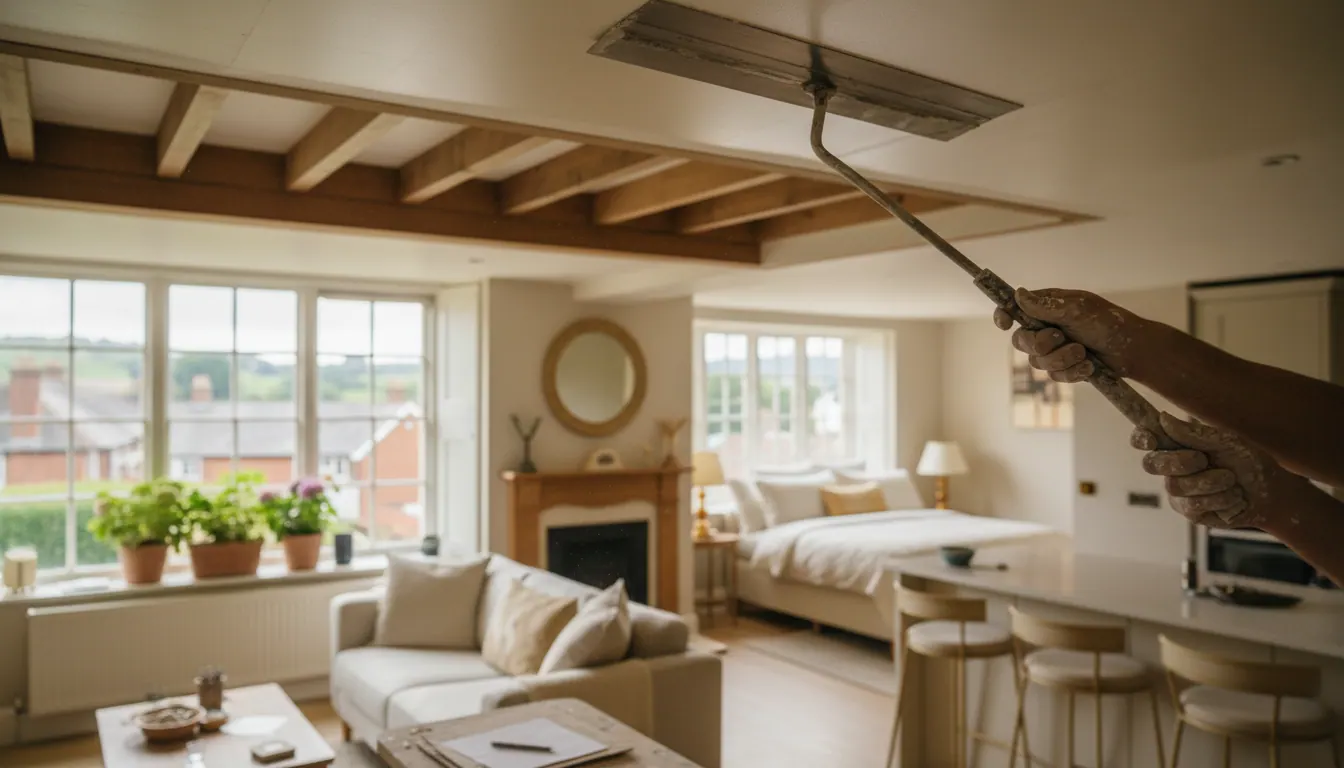
Boarding a ceiling is more physical than boarding a wall. The boards go up overhead, they need to be held in position while fixings go in, and the skim coat needs to be applied to a surface you are working against gravity to reach. It is the kind of job where experience shows.
Once a ceiling is boarded and skimmed, the difference is striking. One of our customers put it well:
"Great job, walls and ceiling done in a couple of days and are smooth and soft and 100% better than before, would recommend very helpful as was unsure how plastering worked. All i need now is a paint :>)"
- Charisma England, via Google
That kind of finish is what we aim for on every job, whether it is a single ceiling in a Bridgwater terrace or a whole house boarding and skim.
Plasterboarding for Commercial and New Build Work in Somerset
Plasterboarding is not only a domestic trade. We carry out boarding and dry lining on commercial projects across Somerset and Dorset too, including offices, educational buildings and healthcare settings.
Commercial jobs often involve metal stud partitioning systems, multiple board layers for fire performance, and the need to work around other trades on a live site. We are used to that environment.
"We have been using james and his team for just over a year now, They offer a wide range of expertise, covering domestic and commercial works Finding a contractor capable of managing the high standards of NHS and education sectors is quite valuable."
- chris withers, via Google
Standards on commercial sites are high, and rightly so. The boarding needs to be right first time because there is no room to go back and redo it once other trades have followed on.
If you are a builder or developer working on new builds in Somerset, we are set up for that kind of work. Machine-applied skim over large areas of plasterboard is an option on bigger sites, giving a consistent finish across a lot of square metres efficiently.
What to Have Ready Before We Arrive
A little preparation on your side makes the job go more smoothly and means we can get straight on with the boarding and skimming.
- Clear the room as much as possible. Furniture, carpets and belongings need to be out of the way. We protect what is left, but the more space we have, the quicker and cleaner the work.
- Make sure services are done. Cables, sockets, switches and any pipework should be in place before boarding starts. Once the boards are up, it is very difficult to add anything without cutting back in.
- Check the frame is finished. If a builder is putting up the stud frame, it needs to be complete and signed off before we arrive to board.
- Allow the boards to acclimatise. If boards are delivered to site, leaving them in the room for a short time before fixing helps them adjust to the conditions.
- Plan for dust. Cutting and fixing boards creates dust. We work tidily, but it is worth covering anything you cannot move.
How the Skim Coat Finishes It Off
Boarding alone does not give you a surface ready to paint. The boards need to be skimmed, which means applying a thin coat of finishing plaster across the whole surface to create a smooth, even face.
The skim coat is what you see and touch when the job is done. It covers the board joints, the fixings and any slight irregularities, leaving a flat surface that takes paint cleanly. A well-applied skim coat should be smooth to the touch with no ridges, trowel marks or hollows.
After skimming, the plaster needs time to dry fully before painting. The colour change from dark to pale is a reliable guide. Painting too soon traps moisture and can cause issues later, so patience at this stage pays off.
Frequently Asked Questions
Do you do plasterboarding in Bridgwater for smaller jobs, not just big sites?
Yes. We take on all sizes of work, from a single partition wall or one ceiling in a Bridgwater home to full boarding and skimming on a new build or commercial fit-out. If you need boarding and skimming done in Somerset or Dorset, get in touch and we will come and have a look.
What type of plasterboard do I need in a bathroom or kitchen?
Moisture-resistant board (sometimes called green board or blue board, depending on the manufacturer) is the right choice in rooms where steam and condensation are a regular factor. We will always specify the right board type for the location so you are not left with problems later.
Can you board over an existing plaster ceiling rather than stripping it?
Sometimes, yes. If the existing ceiling is sound but uneven or tired, boarding over it can be a practical option. If it is failing, loose or damaged, it is usually better to strip it back and start fresh. We will take a look and give you an honest view before we start.
Do I need to move out while plasterboarding and skimming is being done?
For most domestic jobs, no. The work is dusty and disruptive in the room being worked on, but the rest of the house is usually fine to live in. For larger whole-house projects it is worth having a conversation about the sequence of works so you can plan around it.
Ready to Get Started?
If you are planning a new partition, a ceiling replacement or a full boarding and skimming job in Bridgwater or anywhere across Somerset and Dorset, we are happy to come and take a look. We quote each job individually once we understand what is needed.
Get in touch with us or call us on 07444 745495 to arrange a free quote.